Understanding the Inbound Baggage Handling System
After a long flight, most travelers focus on one thing: retrieving their baggage. Meanwhile, as you stretch your legs or head for that first cup of coffee, your luggage begins its own journey through the airport’s inbound baggage handling system. This process determines how efficiently bags move from the aircraft to the claim hall. Whether an airport uses slope plates, flat plates, or an inbound sortation system, understanding what happens behind the scenes helps explain how bags make that final connection back to passengers.
At this stage of the trip, the inbound baggage handling system represents the final chapter of your luggage’s journey after touchdown. Because every airport operates within different constraints, system design varies based on terminal layout, passenger volumes, and available ground service equipment. With that in mind, the following section breaks down what happens from the moment the aircraft parks at the gate to the point when your bag arrives on the claim device.
What Happens to Your Inbound Baggage Upon Landing
When your aircraft arrives, ground service crews move into position and begin unloading operations. At that point, the inbound baggage handling process starts as ramp agents remove luggage from the aircraft hold and place it onto baggage carts. From there, the carts transport bags to the inbound system for delivery to the claim area. At large airports, automated load belts feed baggage to multiple claim devices, while smaller airports often rely on ground service equipment to deliver bags directly to flat-plate claim units.
In contrast, major hubs such as JFK, DFW, and LAX use inbound sortation systems capable of processing thousands of bags per hour. At smaller airports like RNO, the process involves fewer system elements but still requires careful coordination. Throughout this stage, each bag tag scan maintains traceability and ensures proper routing. Meanwhile, ground handlers perform physically demanding work, lifting and maneuvering bags within tight turnaround windows. As a result, their precision plays a direct role in ensuring your luggage arrives on the correct carousel.
For those who want to dive deeper, the Department of Transportation provides an overview of rules and regulations regarding baggage. Please also check out this article from Airport News Now where we take a peek behind the curtain to see how the TSA screens checked baggage.
Personal Experience With Airport Inbound Baggage Claim Devices from Way Back When
Years ago, early in my engineering career, I had the opportunity to help design several baggage claim devices at Rochester International Airport (ROC). Many years later, I returned to ROC and saw those same systems still operating and in active service.
In this video, two slope plate claim devices are visible, part of a four-claim layout that serves the ROC inbound baggage claim hall. Seeing these units still functioning as intended highlights how durable system design and proper maintenance support long-term airport operations and reliable baggage delivery for travelers.
From Aircraft to Claim Device: The Role of GSE Delivery
Many domestic airports rely on ground service equipment–based delivery for inbound baggage. After the aircraft parks, ramp crews unload bags into carts and tow them to the terminal. From there, crews manually place the luggage onto flat-plate claim devices. For this reason, the approach keeps capital costs low and simplifies maintenance, making it well suited for regional and medium-sized airports.
However, this method presents operational challenges. For example, human error can cause misloads when multiple flights arrive at the same time. In addition, weather conditions and ramp congestion can delay cart movement and slow delivery to the claim area. Because GSE-based delivery lacks automation, timing depends heavily on how quickly crews offload, transport, and place bags onto the claim system.
Even so, GSE delivery remains one of the most practical inbound baggage handling solutions. As a result, it offers a balance between efficiency and flexibility while allowing airports to accommodate a wide range of aircraft types without major infrastructure investment.
Inside the Automated Inbound Baggage Handling System
Larger airports implement automated inbound sortation systems to increase processing speed and reduce reliance on manual labor. In these configurations, baggage moves from the aircraft to the terminal through powered conveyor belts that feed directly into inbound load belts. As each bag enters the system, an Automatic Tag Reader scans the barcode on the IATA tag and captures routing data.
From there, the system applies pre-programmed logic to direct each bag toward its assigned claim device. For example, when multiple flights arrive at the same time on different airlines, the inbound matrix can handle all bags simultaneously. In that case, the ATR routes each bag to the correct claim device based on flight number and carrier. As a result, automation improves routing accuracy, reduces congestion in the claim hall, and makes the inbound baggage handling process more consistent and less susceptible to human error.
An inbound sortation matrix typically includes:
- Inbound load belts that receive baggage from GSE or pier belts.
- Photo-eye sensors to track bag movement and prevent jams.
- Diverters that guide bags to specific claim units.
- Feed belts that discharge bags onto the slope or flat plate device.
These components work together to balance flow and minimize backup at each claim device. The International Air Transport Association (IATA) offers detailed standards for tagging, tracking, and sorting automation, ensuring global compatibility.
Book Your Ride After You Grab Your Bags
After you collect your bag in the inbound baggage hall, the next step involves leaving the airport efficiently. For this reason, the Travelpayouts Airport Shuttle & Transfer Search Widget helps you arrange ground transportation before you step outside. The tool shows real-time shuttle and transfer options, which prevents unnecessary waiting or wandering with heavy luggage while trying to make decisions on arrival.
As a result, you can secure a ride that aligns with your arrival time and luggage needs. In addition, planning ahead keeps the transition from the claim carousel to your hotel direct and predictable, reducing delays and avoiding confusion at the curb.
Types of Claim Devices in a Baggage Claim Hall
Flat Plate Baggage Claim Devices
Flat plates are common in smaller or regional airports. In these systems, flat rotating platforms made up of metal slats present bags directly to passengers. After ramp agents or inbound feeds place luggage onto the plate, the carousel delivers bags in a continuous loop for easy access.
For this reason, flat-plate systems use fewer mechanical components and require less maintenance than more complex claim devices. As a result, they offer a cost-effective solution for airports with lower passenger volumes while still providing reliable baggage delivery.
Slope Plate Baggage Claim Devices
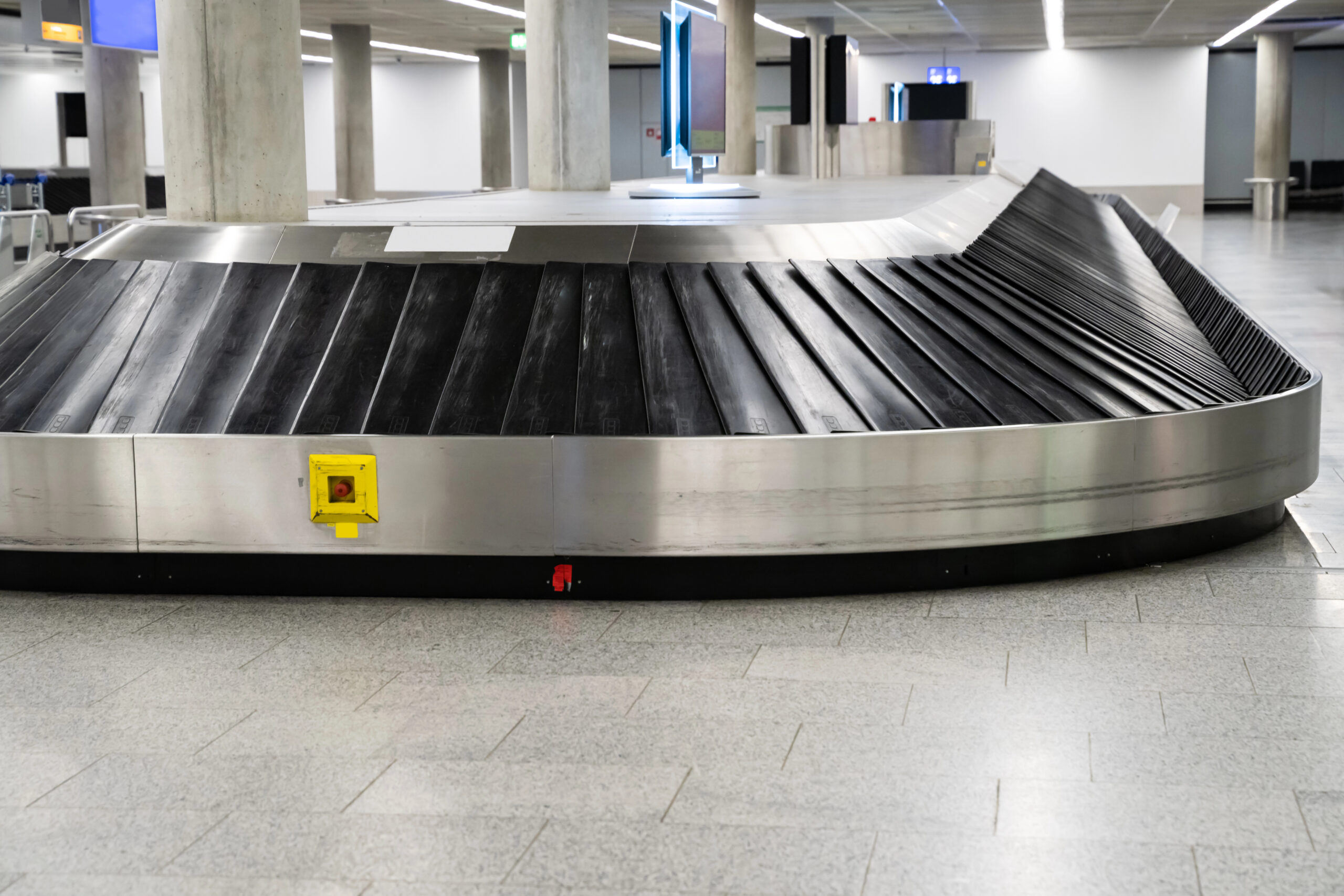
Slope plates dominate larger airports because they support higher baggage volumes. Unlike flat plates, these carousels use angled, overlapping plates that move luggage upward and outward from the discharge point. As a result, the slope design increases usable surface area and allows higher bag density without reducing passenger access. For this reason, airports that handle tens of thousands of bags per day rely on slope plate devices for consistent throughput and durability.
At the same time, both slope plates and flat plates connect to the inbound baggage handling system through controlled discharge points. This design regulates bag flow, distributes luggage evenly, and prevents pileups at the claim device. Ultimately, the difference comes down to operational priorities: slope plates support volume and throughput, while flat plates prioritize lower cost and simpler maintenance.
The Passenger Experience: Baggage Claim Halls and Flow Design
Airports design baggage claim halls to manage passenger flow efficiently. For this reason, planners arrange claim units in loops or U-shaped configurations, which allow multiple flights to discharge luggage at the same time. In addition, designers separate each device’s feed area to create more space for passenger queuing while still maintaining clear sightlines to arriving bags.
At the same time, travelers play a role in keeping the process moving. Rather than crowding near the discharge chute, step back and allow the system to circulate. Because every claim device operates as a closed-loop system, your bag will come around again. As a result, standing too close creates bottlenecks and slows retrieval for everyone. Giving others space allows ramp crews or automated systems to work efficiently and keeps the claim area flowing as intended.
For travelers waiting at major airports, websites like FlightAware Baggage Tracker and SITA BagJourney provide digital tools to check your baggage progress in real-time.
Baggage Identification: Standing Out Without Slowing Down
It’s easy to lose track of your bag among hundreds that look similar. For this reason, avoid gimmicks such as tying shirts or scarves to your luggage, since loose items can snag in the inbound sortation system and delay routing. Instead, use brightly colored luggage straps or tightly secured custom tags that attach directly to the handle.
As a result, these accessories make your bag easy to identify while remaining compatible with automated systems. In addition, they reduce the risk of interference with the Automatic Tag Reader by keeping barcodes unobstructed. Choose durable materials with secure buckles and avoid anything that dangles or frays. By investing in properly designed travel accessories, you protect your belongings and support smoother operation of the inbound baggage handling system.
Inbound Baggage Etiquette: The Traveler’s Role
PasPassengers also play a role in keeping the inbound baggage handling process moving smoothly. For this reason, a few simple habits can make a measurable difference. First, stand back from the belt to give others room to retrieve their bags without congestion. Next, check the baggage tag before leaving the claim area to confirm the name and flight number match your ticket. In addition, remain patient, since bags often arrive in groups based on aircraft unloading order.
Ultimately, airports design claim halls to encourage efficient flow, but passenger behavior determines how well that design functions in practice. When travelers stay aware and allow the system to work as intended, the entire inbound baggage process operates more smoothly for everyone involved.
The Evolution of Inbound Systems: What’s Next
Technology continues to redefine how airports handle baggage. As systems evolve, the next generation of inbound baggage handling solutions will incorporate artificial intelligence and machine learning to predict delays, adjust belt speeds, and balance loads across multiple claim devices. In addition, some airports already deploy robotics for cart-to-belt transfers, which reduces manual lifting and improves placement accuracy.
At the same time, identification technology continues to advance. Radio Frequency Identification (RFID) is steadily replacing traditional barcodes and offers significantly higher tracking reliability throughout the baggage journey. According to recent IATA reporting, RFID adoption has reduced mishandled baggage rates by more than 20 percent. As a result, airlines and airports continue to expand RFID programs, with widespread implementation expected by 2026 as infrastructure modernization accelerates.
For more insight, visit IATA’s Baggage Tracking Initiative.
Final Thoughts: The Last Leg of Your Bag’s Journey
When you stand in the baggage claim hall watching familiar suitcases roll past, take a moment to consider the network of conveyors and the crews that bring your luggage to the carousel. From aircraft offload to final delivery, the inbound baggage handling system functions as a coordinated ecosystem of people and machines.
With that in mind, take a breath and let the process work. Give others space around the claim device, keep your luggage clearly identifiable, and allow the system to operate as designed. When everything works correctly, your bag appears exactly where it should. That outcome reflects careful planning, disciplined operations, and engineering systems that make complex processes feel seamless.
Affiliate Disclosure:
Some links in this article direct you to third-party travel partners, booking platforms, and service providers. If you purchase a product, book a reservation, or sign up for a service through these outbound links, Airport News Now may earn a commission from the merchant at no additional cost to you. These commissions help support the site’s research, writing, and operations.
Airport News Now maintains full editorial independence. All recommendations are based on real traveler needs, operational airport knowledge, and objective evaluation — never on commission potential. You are under no obligation to use these links, but doing so helps keep the website free and accessible for all readers.
For more information on affiliate partnerships, please review each vendor’s official policies on their respective websites.